
By Head of Growth & Performance | AAYI Digital | 12+ years in SEO, paid media, and full-funnel marketing | 150+ Chennai brands scaled across OMR, Anna Nagar, Velachery, T. Nagar, and Adyar
The conversation that changed how I think about marketing
I still remember sitting across from a retail brand owner in T. Nagar in early 2024. He had just completed a three-month, ₹3 lakh engagement with a “premium” digital agency. The deliverables were impressive on paper — 50+ Instagram posts, professionally shot reels, a 200% spike in profile reach, and a detailed monthly report with colorful graphs.
He slid the report across the table. “Look at this reach,” he said.
Then he pointed at his point-of-sale system. “Now look at this.”
Four walk-in customers in ninety days who could actually trace their visit back to digital. Four.
We took him on as a client. Within sixty days, his cost per verified walk-in customer dropped from ₹4,800 to ₹620. By month four, his monthly footfall from digital had increased 340% and his overall cost per acquisition had stabilised below ₹800 — a number his business could sustain and scale.
The difference was not budget. His budget actually went down. The difference was accountability. Every rupee was tied to a measurable outcome. That is performance marketing — and that story is why this piece exists.
That silence in his office? That is the measurement crisis. And in 2026, with Google AI Overviews absorbing traditional clicks and budgets getting tighter from OMR to Anna Nagar, that silence is the sound of money burning across Chennai boardrooms every single week.
What performance marketing actually means in 2026
When a business owner searches “performance marketing services near me” in Chennai, they are not looking for another agency to post reels. They are looking for a partner who treats every rupee like their own and can show — in plain numbers — what came back from it.
Performance marketing is an accountability system. You pay for results. Clicks that convert. Leads that turn into customers. Revenue that hits your bank account. Every channel, every campaign, every creative is measured against a clear outcome.
Here is what that looks like in real Chennai benchmarks from our own campaigns — not Silicon Valley projections:
Cost Per Acquisition (CPA) tells you what you actually pay to get one paying customer. For a B2B services firm in OMR, a healthy CPA might be ₹1,500 to ₹3,000. For a D2C product brand in T. Nagar, it could be ₹300 to ₹800. The number only matters in context of your average order value and customer lifetime value.
Return on Ad Spend (ROAS) measures how many rupees come back for every rupee spent on advertising. Across our Google Ads campaigns for Chennai service businesses, we consistently see 3.5:1 to 5:1. Meta campaigns for D2C brands typically run 3:1 to 6:1 depending on product category, creative quality, and funnel depth. These are real numbers from real campaigns — they vary by industry and are not guaranteed, but they give you a benchmark worth comparing your current results against.
Conversion rate is where most businesses quietly lose money. Industry average for a Chennai service business website is around 1% to 1.5%. A well-optimised landing page for a specific service category in a specific Chennai location can reach 4% to 6%. Moving from 1% to 3% on the same traffic triples your leads for zero additional ad spend.
At AAYI, our working philosophy is simple: strong product, authentic brand, performance data driving every decision. We use AI tools to move faster. We use human judgment to make sure nothing sounds like it was written by a machine. Because Chennai customers can tell the difference — and they remember.
The honest truth about traditional digital marketing
Traditional digital marketing — social media management, brand awareness campaigns, basic SEO without tight attribution — is not useless. It is incomplete on its own.
It does something performance marketing cannot do alone: it builds the kind of familiarity that makes a paid ad convert more efficiently. When someone in Velachery has seen your brand three times on Instagram before they click your Google Ad, that click converts at a higher rate. That is the brand moat that traditional marketing builds.
The problem is not traditional marketing. The problem is selling it as a complete solution when it is actually a supporting layer.
Every week we sit across from Chennai founders who have been paying for activity instead of outcomes. A 40% jump in reach sounds good until you ask how many of those reached people became customers. If the agency cannot answer that question clearly, you are paying for metrics that do not connect to your cash register.
In 2026, with Google AI Overviews now directly answering search queries that used to send users to websites, pure awareness campaigns have lost some of their organic reach value. The brands that compensate by building a tighter connection between their content strategy and their performance layer are the ones holding their ground. The brands running pure awareness plays are watching their traffic graphs diverge from their revenue graphs — up and up on impressions, flat on income.
The intelligence phase: understanding your competitive landscape before spending a rupee
Before we spend anything on ads or write a single piece of content for a new client, we do something most agencies skip entirely: we reverse-engineer what is actually working for their competitors in Chennai.
This is not guesswork or gut feel. It is a structured audit of the competitive landscape across the specific geographies and service categories that matter to your business — whether that is OMR tech parks, Adyar residential clusters, Anna Nagar local services, or T. Nagar retail.
We look at funnel structure first. Are competitors sending traffic to a generic homepage or a dedicated landing page built for a specific service and location? Most send traffic to their “About Us” page. That is equivalent to inviting someone to dinner and making them find the kitchen on their own.
We look at ad creative and offers. Which messaging themes are generating engagement? Which offers are being tested repeatedly — which usually means they are working? We study Google Ads copy, Meta creatives, and YouTube pre-roll ads across the competitive set.
We look at traffic sources. Is a competitor winning on organic search, paid media, or referral traffic? How long has that channel been their primary driver? A competitor who built their organic traffic over three years through consistent content cannot be outranked in two months — but a competitor whose paid results are weak can often be undercut immediately.
This intelligence work routinely reveals that the biggest competitor in a given Chennai category is leaving significant money on the table. They have a strong top-of-funnel but a leaking conversion layer. That leak is your opportunity.
Keyword gap analysis: finding the searches your competitors are ignoring
Most businesses in Chennai fight expensive battles over broad, high-competition terms like “digital marketing agency” or “SEO company Chennai.” These terms attract researchers, students, and competitors as much as actual buyers. They also cost ₹200 to ₹500 per click on Google Ads, making efficient acquisition nearly impossible at those rates.
The better opportunity is in high-intent, location-specific phrases that competitors have not properly targeted. Searches like “performance marketing services in Chennai near me,”
“lead generation services Velachery,” “conversion rate optimisation agency OMR,” or “digital marketing agency in Adyar for service business” show active buying intent. The person searching these is not researching — they are looking to hire.
These longer, more specific phrases typically convert two to three times better than broad terms and cost fifty to seventy percent less per click because competition at this level of specificity is lower. According to Think with Google data, local intent searches — those including “near me” or a specific location — have grown over 500% in the past five years and are increasingly connected to immediate purchasing decisions (Think with Google, Local Search Trends, 2024).
We map the keyword landscape across your competitors, identify which high-intent phrases they rank for and which they have missed entirely, and build a content and paid strategy that targets the gaps first rather than fighting head-on for the expensive broad terms.
Content strategy: building authority that ranks and gets cited by AI
Google’s EEAT framework — Experience, Expertise, Authoritativeness, Trustworthiness — was already important before AI search. In 2026, with AI Overviews synthesising content from multiple sources and presenting a single answer, EEAT is effectively the ranking currency. Content that cannot demonstrate genuine first-hand experience and specific expertise does not get cited.
Most competitor blogs in any Chennai marketing category are 500 to 800 word surface-level posts that restate definitions without adding anything a founder could actually use. They exist to tick a “posting weekly” box. They rank for almost nothing and convert even less.
Our approach is different in one specific way: every piece of content we produce is built around questions that real Chennai business owners actually ask — questions that come from sales calls, client meetings, and direct conversations, not from keyword tools alone. Questions like “How do I know if my current agency is wasting my budget?” or “What does a healthy cost per acquisition look like for a service business in Velachery?” or “How do Google AI updates affect my visibility in local searches in Chennai?”
We structure everything for both human readers and AI extraction — clear H1, H2, H3 hierarchy, direct answers within the first hundred words of each section, FAQ schema, and original data points that no other source can replicate. This approach is what gets content cited in Google AI Overviews, surfaced by Perplexity, and referenced by ChatGPT Search. When an AI platform answers a question about performance marketing in Chennai, we want that answer to be built on our content.
The full-funnel growth system: how Chennai buyers actually decide
Nobody sees one ad and buys. The average B2B buyer in Chennai has between six and twelve brand touchpoints before making a decision, according to LinkedIn’s B2B Institute research (2024). For B2C, the number is lower but the principle is the same — your marketing must meet potential customers at every stage of their decision journey, not just the moment they are ready to purchase.
Top of funnel — awareness and curiosity. People searching “how to grow my business in Chennai” or “what is performance marketing vs traditional digital marketing” are in research mode. They are not ready to buy. The goal here is to educate genuinely, demonstrate expertise, and plant your brand as the credible authority in their mind before the buying decision begins. We use long-form blog content, YouTube explainers, and LinkedIn thought leadership for this stage.
Middle of funnel — trust and consideration. Now they know they have a problem and they are comparing solutions. Searches shift to “best digital marketing agency in Velachery” or “AAYI reviews vs competitors.” This is where most agencies lose leads — they make strong first contact and then go silent, leaving the potential client to form their own conclusions without guidance. We use detailed case studies with real numbers, transparent methodology explanations, client testimonials, retargeting ads across Meta and Google, and email nurture sequences at this stage. Research from Marketo shows nurtured leads convert at four to five times the rate of cold leads (Marketo Engage, B2B Benchmark Report, 2023).
Bottom of funnel — decision and conversion. The buyer is ready. They are searching “hire performance marketing agency Chennai” or “AAYI pricing.” At this point, every friction point on your website costs you a customer. We build dedicated landing pages for each service and location combination, optimise page load speed (Google’s own data shows a one-second delay in load time reduces conversions by approximately 7% — Google/Deloitte Mobile Speed Study, 2019), add click-to-call and calendar booking options, and strip every unnecessary form field. A form that takes five minutes to complete loses most buyers before they finish it.
Conversion rate optimisation: the lever most brands ignore
Sending more traffic to a poorly converting website is like pouring water into a bucket with holes in the bottom. You pay more to lose more.
If your current website converts at 1% and you double your ad spend to double your traffic, you have doubled your wasted opportunity at the same time. The fundamental problem — your website is not converting the visitors it already gets — remains completely unaddressed.
Conversion Rate Optimisation fixes the bucket before you pour more water. We test headlines (does the core value proposition come through in under three seconds?), form length (are you asking for more information than you need at this stage?), navigation structure (can a visitor find your specific service offer within two clicks?), mobile experience (the majority of Chennai search traffic happens on mobile, and a desktop-optimised site on a phone loses buyers at every scroll), and page load speed.
Moving from 1% to 3% conversion on the same existing traffic triples your lead volume. No additional ad spend. No new content. Just fixing what is already broken in the current experience.
In 2026, CRO is not optional for any business spending meaningfully on traffic acquisition. It is the highest-leverage activity available in most marketing programmes.
Winning in AI search: AEO and GEO in practice
Search is not blue links anymore. When someone asks Google about performance marketing agencies in Chennai, they may see an AI Overview synthesising answers from multiple sources before they see a single traditional search result. The same question on Perplexity or ChatGPT Search gives a generated answer that may or may not reference your business.
Answer Engine Optimisation (AEO) means structuring content so AI systems can pull clear, direct answers from it. Practically, this means putting the direct answer to the section’s question within the first two sentences, using logical heading hierarchies, including FAQ schema markup, and writing in language that is quotable — specific, factual, and concise enough to be extracted.
Generative Engine Optimisation (GEO) goes further — it is about becoming a source that AI platforms trust enough to cite consistently. This requires original data and insights that exist nowhere else (which is why our campaign benchmarks in this article matter — they are not available from any other source), strong entity signals (consistent business name, location, services across all platforms), and presence on the platforms that AI systems draw from most heavily — LinkedIn, YouTube, authoritative business directories, and publications in your industry.
In practice for AAYI: one of our client case studies on conversion rate optimisation for a Chennai e-commerce brand was cited in a Perplexity response to the query “CRO results for Indian e-commerce” within three months of publication. That citation drove 340 referral visits over the following six weeks — traffic that cost nothing and arrived with pre-built trust because it came through an AI recommendation rather than an ad.
This is what GEO looks like when it works. It takes time and original content to get there, but the traffic quality is unlike anything paid media produces.
Local dominance: owning “near me” searches across Chennai
Chennai is not a single market. A business owner searching from an OMR tech park on a Tuesday afternoon has completely different intent and context from someone searching from Anna Nagar on a Saturday morning. Local optimisation that treats Chennai as one homogeneous market misses this entirely.
Your Google Business Profile is the foundation. Complete profile with accurate service categories, updated hours, regular posts, photos of actual work and team (not stock images), and responses to every review — positive and negative. An unanswered negative review tells every prospective customer that you do not engage with client concerns.
Map pack visibility for “digital marketing agency near me” and service-plus-location searches requires consistent NAP (Name, Address, Phone) information across every directory your business appears in, location-specific backlinks from Chennai-based publications and directories, and genuine reviews from verified customers. According to BrightLocal’s Local Consumer Review Survey (2024), 87% of consumers read online reviews before choosing a local business — and the quantity and recency of reviews are among the top three factors in map pack ranking.
Location-specific service pages — performance marketing in OMR, lead generation services in Adyar, digital marketing agency in Anna Nagar, CRO services in T. Nagar, SEO services in Guindy — each targeting the specific intent of searchers in that area, give your organic search presence a depth that a single generic “services” page cannot achieve.
Analytics, automation, and scaling without burnout
Manual follow-up does not scale. If you are sending individual follow-up emails or tracking leads in a spreadsheet, you are creating a ceiling on your own growth — not because the work is not valuable, but because it cannot keep up with volume as your pipeline grows.
Marketing automation handles the consistent, repeatable parts of lead nurturing — instant response when a form is submitted, a sequenced email series that delivers value over the following two weeks, a reminder before a scheduled call. This keeps your brand present in a prospect’s mind during the consideration phase without requiring manual effort for every interaction.
Proper attribution answers the question every founder eventually asks: which channel is actually responsible for that sale? First-click attribution gives all credit to the first touchpoint. Last-click gives it to the final one. Neither is the full picture. Multi-touch attribution models distribute credit across the entire customer journey and give you a much more accurate view of what is actually working — which is what you need to make good decisions about where to increase spend and where to cut it.
Custom dashboards showing CPA, ROAS, conversion rates, and customer lifetime value by channel and campaign — not vanity metrics like reach and impressions — are what separate businesses that make confident marketing decisions from those that guess and hope. When the data is clean and visible, decisions become obvious.
Why the hybrid approach is the only one that makes sense in 2026
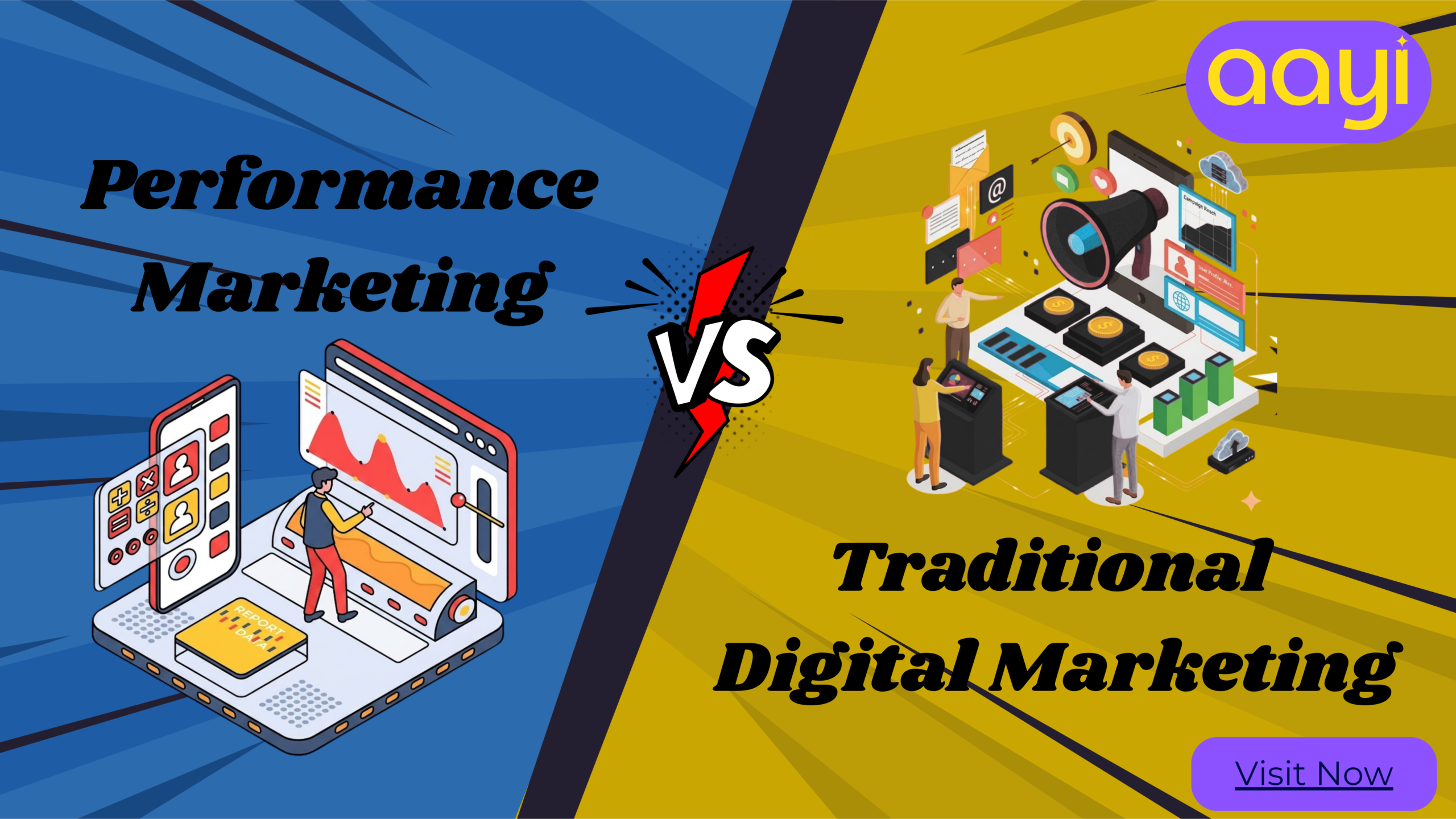
| Traditional Digital Marketing | Performance Marketing | |
| Primary function | Builds brand equity and long-term trust | Drives measurable, immediate revenue |
| Time horizon | Months to years | Days to weeks |
| Measurement | Difficult — reach, impressions, sentiment | Clear — CPA, ROAS, conversion rate |
| Funnel position | Top of funnel (awareness) | Bottom of funnel (conversion) |
| Weakness | Hard to connect to revenue | Expensive without a brand to support it |
| 2026 status | Diminished by AI search eating organic clicks | More important as brand moat matters more |
Pure traditional marketing gives you reach with no accountability and no clear path from awareness to revenue.
Pure performance marketing gives you short-term returns but no brand equity — you pay full acquisition cost for every single customer because nobody already knows or trusts you.
The hybrid approach uses traditional and organic to build the brand recognition that makes performance campaigns cheaper over time — because people who have already encountered your brand convert at higher rates when they see your paid ads. And it uses performance channels to generate immediate, measurable revenue while the longer-term organic work compounds in the background.
At AAYI, this is the system we build for every client. Strategy, funnel architecture, CRO, automation, analytics, local optimisation, and AI readiness working as one integrated programme — not a collection of separate tactics from separate vendors with no coordination between them.
Before you leave — take this with you
If you are tired of reports that celebrate reach while your revenue stays flat, the problem is not your budget. It is the accountability structure around how that budget is being deployed.
The brands winning in Chennai in 2026 are not the ones spending the most. They are the ones measuring the right things, optimising relentlessly based on real data, and building a system where every channel — paid, organic, content, local — reinforces every other channel.
If you want to know where your current setup stands — which channels are working, which are wasting budget, and what a competitor gap analysis reveals about your specific market — we offer a free thirty-minute audit call. We will look at your current funnel, your competitor landscape in your specific Chennai area, and your conversion rates, and give you a clear picture of where the highest-leverage improvements are.
Looking for performance marketing services or a digital marketing agency near you in Chennai? Book your free audit call at [aayi.in/audit] .or call us directly at [+91 75981 70356].We will have a clear picture of your situation before the call ends.
Frequently Asked Questions
What is the main difference between performance marketing and traditional digital marketing? Traditional digital marketing focuses on building awareness, reach, and brand familiarity — activities that pay off over months and years but are difficult to connect directly to revenue in the short term. Performance marketing ties every activity to a specific, measurable outcome — a lead, a sale, a booked appointment — with clear tracking of cost per result. In practice, neither approach is complete without the other. Traditional builds the brand trust that makes performance campaigns more efficient over time, while performance generates the immediate revenue that funds the broader marketing investment.
Why should a Chennai business specifically choose a local performance marketing agency? A Chennai-based agency understands the specific intent differences between someone searching from an OMR tech corridor versus a T. Nagar retail area versus an Adyar residential cluster. These are not the same buyer in the same mindset and they should not be targeted with identical messaging. Local expertise also means familiarity with the competitive landscape in your specific category and geography — which competitors are spending, where they are weak, and which keywords they have left uncontested. This market knowledge translates directly into more efficient campaigns and faster results.
Does performance marketing include SEO, or are they separate? In 2026, they are inseparable if done well. Technical SEO and content strategy build organic authority that lowers your paid acquisition costs over time — a brand that ranks organically for high-intent terms does not need to bid as aggressively on those same terms in Google Ads. Conversely, paid campaign data reveals which keywords and messages are converting right now, which informs the content strategy for organic. The best programmes treat paid and organic as a single integrated system with shared data, not two separate budgets with separate teams.
How do you identify keyword gaps that competitors have missed? We start with a full audit of what your top three to five competitors rank for organically and what they are bidding on in paid search. We then map those terms against your current rankings and identify two categories: terms where competitors rank but you do not, and high-intent terms that nobody in your category has properly targeted yet. The second category is consistently the most valuable — local, service-specific, long-tail phrases where competition is low and buyer intent is high. These are the terms that deliver the best cost-per-acquisition results, particularly for businesses in specific Chennai areas targeting specific service categories.
What is Answer Engine Optimisation (AEO) and does my business need it? AEO is the practice of structuring your content so that AI-powered search systems — Google AI Overviews, Perplexity, ChatGPT Search, and others — can extract and cite your content when answering relevant queries. It matters because an increasing share of search queries in 2026 are answered directly by AI without the user clicking through to any website. If your content is not structured to be extractable and citable, you are invisible to this growing portion of search behaviour. For a Chennai business, AEO means ensuring your most important service and location pages answer specific questions directly and concisely in the first paragraph of each section.
How long does it take to see results from performance marketing? Paid search and paid social campaigns typically show initial data — enough to make meaningful optimisation decisions — within two to four weeks of launch. Meaningful revenue results, with enough volume to be statistically reliable, generally take six to eight weeks. Organic content and SEO efforts operate on a longer timeline — three to six months before significant ranking movement, six to twelve months for consistent organic lead generation. A well-structured hybrid programme uses paid channels to generate revenue immediately while organic builds in the background, so you are not waiting six months to see any return at all.
What does conversion rate optimisation actually involve? CRO is the systematic process of improving the percentage of website visitors who take the action you want — filling a form, calling, booking, or buying. In practice it involves testing alternative headlines to find which communicates your value proposition most clearly, simplifying forms to ask only for information genuinely needed at that stage, improving page load speed (a one-second delay reduces conversions by approximately 7% according to Google’s own research), restructuring navigation so the path to your core offer requires fewer clicks, and optimising the mobile experience specifically — because the majority of Chennai search traffic arrives on mobile devices. CRO is consistently the highest-return activity in a mature marketing programme because it multiplies the value of every other channel without requiring additional spend.
What metrics should I actually be tracking — and which ones should I ignore? Track CPA (what does it cost to acquire one paying customer?), ROAS (how many rupees come back for every rupee spent on ads?), conversion rate by channel and landing page, and customer lifetime value (what is the total revenue a typical customer generates over their relationship with your business?). These four metrics tell you everything that matters about whether your marketing is working. Deprioritise reach, impressions, follower counts, and engagement rate as primary success metrics — they describe activity, not outcomes. They have their place as diagnostic signals, but they should never be the headline numbers in a performance marketing report.
How much should a Chennai business budget for performance marketing? There is no universal answer, but a useful starting framework is this: your marketing budget should be a percentage of your target revenue, not your current revenue — and performance marketing specifically should be sized based on your target CPA and the number of customers you need to acquire. If your target CPA is ₹2,000 and you need fifty new customers per month, your monthly performance marketing budget needs to be at least ₹1,00,000 to generate the required volume with room for testing and optimisation. Starting below this threshold means not enough data to optimise effectively. We help clients work backwards from revenue targets to the budget required to reach them.
What makes AAYI’s approach different from other Chennai digital agencies? The specific difference is integration. Most agencies run paid, organic, content, and local SEO as separate services with separate teams and separate reporting. We build one connected programme where data from paid campaigns informs the organic content strategy, CRO improvements benefit every traffic channel simultaneously, and the analytics dashboard gives a single view of the full customer journey from first touchpoint to revenue. The second difference is accountability — we track and report on the metrics that connect to your revenue, not the activity metrics that make reports look good but do not explain what happened to your cash register.
About the author
By Head of Growth & Performance | AAYI, Chennai. Over twelve years in digital marketing, he has led SEO strategy, performance media, and growth systems for more than 150 brands across Tamil Nadu, with a concentration in Chennai’s OMR, Anna Nagar, Velachery, T. Nagar, and Adyar markets. His work spans B2B technology firms, D2C product brands, professional services practices, and retail businesses. He writes about performance marketing, conversion optimisation, and the practical implications of AI search for Chennai business owners.